Introducing Hope in a Secular Age
In this introductory post, Devin Singh and Rick Elgendy introduce the main themes of Hope in a Secular Age and summarize the interventions of each contributor to the symposium.
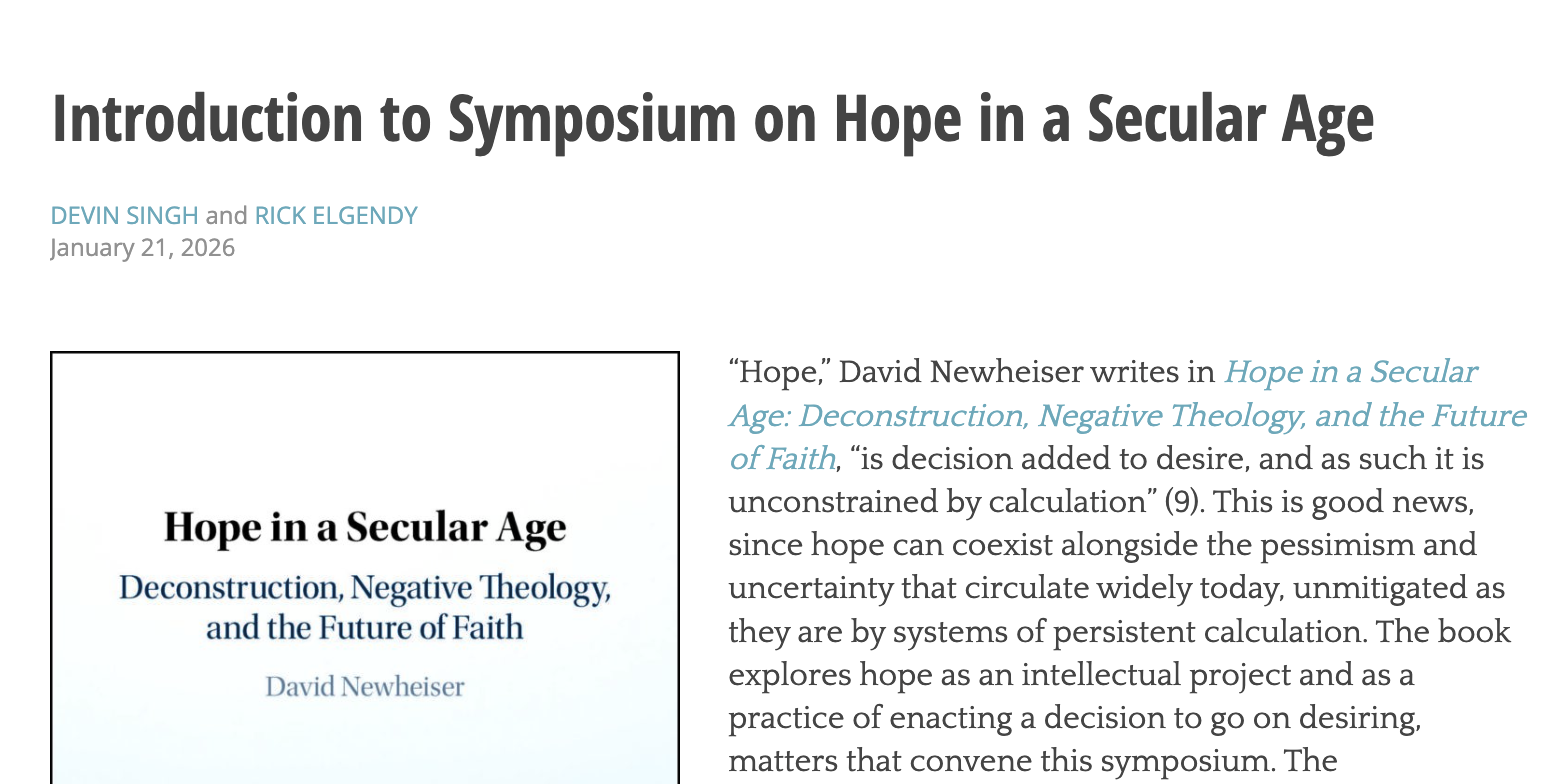
In this introductory post, Devin Singh and Rick Elgendy introduce the main themes of Hope in a Secular Age and summarize the interventions of each contributor to the symposium.

I was interviewed by CNBC about why student loan forgiveness debates spark such anger and backlash. The linked article captures some of my answer and includes perspectives from other experts. Below is my full response:
Hi Professor Singh,
Hope this email finds you well. I’m a reporter at CNBC, working on a story about why the idea of student loan forgiveness in the U.S. makes some people just so heated. I’ve been covering student debt related issues for years, and whenever there’s forgiveness, the angry emails and comments pour in. I thought you might have some really interesting thoughts, and I’d love to hear from you! Questions below:
—Why do you think student loan forgiveness is such a partisan issue in the U.S.?
—Why, do you think, are some Americans so angered by the idea of college graduates getting their debts forgiven? What is it about student loan forgiveness?
—What role might envy play? Or the fact that most Americans don’t have a college degree?
—Why do some have such strong beliefs that repaying debt is moral/responsible?
Answers:
One reason why loan forgiveness is such a partisan issue is that members of each party have different relationships to the educational system. Statistically, a higher percentage of Democratic voters graduated from a four-year college and/or attended graduate school. So student loan forgiveness may affect more Democrats than Republicans directly. The fact that most Americans don’t have a college degree may also mean that many resist loan forgiveness because student debt is not their problem and so forgiveness does not appear to directly benefit them.
A second reason is that, stereotypically, members of each party view education slightly differently. While both sides view education practically as a means to an end of securing a better job and higher salary, Democrats may also express views about education contributing to the public good and supporting an engaged citizenry.
These different views about education as well as different understandings of justice are behind some of the anger and debate.
Some who oppose student loan forgiveness view education as a private commodity that benefits the person who purchases it. Using a transactional model of justice that believes you should pay for the good you require, it appears unfair and unjust that somebody should get something for free (or at a discount) after agreeing to pay (full price) for it. Since the benefit of education goes only to the person who is educated, the idea that society might support their education through loan forgiveness also appears unreasonable and unjust.
Others who support student loan forgiveness view education as both a private and public good, benefiting the individual as well as the society to which the person contributes. It’s important to note that such contribution is not just about economic productivity, but includes things that might benefit the shared way of life of any society, like new ideas, cultural products like art, film, and books, or better laws and ways to govern, for instance. Since the benefit of the education goes to the individual as well as to society, the idea that society might share support for their education through loan forgiveness can appear logical and just.
In the first view, justice is about the fitting consequences for individual choices. In the second view, justice can include that, but also includes accounting for how individuals do not operate in a vacuum. Their choice to pursue education is influenced by many social factors in addition to their education having broader social benefits. Justice here should account not only for the individual and their transactions but for the role of the social system in shaping their transactions and benefiting from them.
For these reasons, I don’t think envy is a helpful way to describe what is happening. While loan forgiveness might certainly feel unfair for some, it is less about feeling jealous than it is a sense of violating some notion of what is right and just. I also think that in the context of political debates, or really, any debates, accusing the other side of envy is unhelpful and unproductive.
As I recall in my forthcoming book, the strong belief that repaying debt is moral comes from really thousands of years of societies describing justice and morality in the terms of debt repayment. For reasons that make sense and were practical, but that also have problematic consequences, many cultures and even religions have used the language of debt to try to explain morality. For many people now, repaying debt “simply is” what moral people do. As I argue, not only has this given debt too much power but it prevents us from understanding the broader world of morality and justice in other important ways.

Singh, Devin. 2018. Divine currency: The theological power of money in the west. Stanford: Stanford University Press.
With contributions by Anna-Riikka Kauppinen, Scott MacLochlainn, Bill Maurer, Daromir Rudnyckyj, and Devin Singh.

In this contribution to a Political Theology Network symposium on economic and political theology, I explore the erasure of the human and the depoliticizing of money that take place in current approaches to the economy.

President Trump speaks Thursday during the White House coronavirus task force briefing at the White House. (Oliver Contreras/SIPA/Bloomberg News)
April 10, 2020 at 6:00 a.m. EDT
In a time of global pandemic and national crisis, market fundamentalism — the unshakable faith that pure capitalism, private enterprise and market forces have almost spiritual power to remedy any situation — represents a grave threat to our nation…
Read the original piece at the Washington Post here.
If you hit the paywall and still need access, you can find a PDF here.

The journal Modern Theology hosted a review symposium on Kathryn Tanner’s Christianity and the New Spirit of Capitalism as well as on Divine Currency. Reviews provided by Nichole Flores (UVA), John Thiel (Fairfield), David Cloutier (CUA), and Philip Goodchild (Nottingham) with responses by Tanner and myself.
Go here to access the issue, or contact me for a PDF if you don’t have access.

Syndicate Symposium on Divine Currency, featuring responses by Alberto Toscano, Danube Johnson, Heather Ohaneson, Sean Capener, and Elettra Stimilli. Introduced by Roberto Sirvent.


As part of a recent initiative by The Immanent Frame on A Universe of Terms, I participated in a contribution around the term “economy.” Here is my reflection.

As part of a symposium around reading lists and “canon” in Political Theology, here is my entry:
“Key texts:
Eusebius of Caesarea, Oration In Praise of Constantine
Augustine of Hippo, City of God Against the Pagans
Delores Williams, Sisters in the Wilderness: The Challenge of Womanist God-Talk
Essential texts:
Marie-José Mondzain, Image, Icon, Economy: The Byzantine Origins of the Contemporary Imaginary
Silvia Federici, Caliban and The Witch: Women, the Body and Primitive Accumulation
Willie Jennings, The Christian Imagination: Theology and the Origins of Race”
Read the full entry and my actual commentary and discussion of these texts HERE.


I recently engaged in dialogue with D. Stephen Long, Cary M. Maguire University Professor of Ethics at Southern Methodist University, about my recent book, Divine Currency. Long offered his review of the book in Marginalia: LA Review of Books, entitled, “Can Christians Be Capitalists?” Given the challenges and critiques he raises, I provided a response, “The Anxiety of Influence.” Check out the exchange!

I recently participated in a book event for Adam Kotsko’s Neoliberalism’s Demons: On the Political Theology of Late Capital. Read my entry and the many great reviews, in addition to Kotsko’s response, here.

I’m often struck by how little I see written about Gen Xers (1965-1980) in the workplace or Gen X leadership. There is, of course, a ton on our younger siblings, the Millennials (1981-1996), and still plenty coming out on our aging Boomer (1946-1964) parents. There’s even a lot of coverage on the tense relationship between those two!
We Xers seem to have been left out of things, which, of course, totally fits our life experience.
But why fail to consider the important challenges faced and contributions made by GenXers in the workplace?
I’m sure there are a few books out there that I’m missing on this topic, but here’s a quick and dirty list of five things that Gen Xers bring to leadership, the workplace, and organizations in general:

November 5, 2018
I spoke with Zachary Settle of The Other Journal in this online interview about my book, Divine Currency.

This summer I received word that I had been selected to participate in a Luce Foundation-funded project called Public Theologies of Technology and Presence, administered through the Institute of Buddhist Studies in Berkeley.
My project, “Decentered Sovereignties and Spectral Transactions: Cryptocurrency, Public Theology, and the Ethics of Presence” will examine the hidden ethical vision of cryptocurrency and evaluate its potential impact on community. Click the link to learn more!

Last year I was interviewed by a Dartmouth student and this profile was recently published. Click the image for a link to a readable online version!

As an extension of his fight against racist laws at home, Martin Luther King Jr. became increasingly critical of US policies abroad. Indeed, many speculate that King’s progressively strident critique of US militarism and intervention, particularly in Vietnam, and his challenge to American market priorities were factors that accelerated plans for his assassination—the 50th anniversary of which we recently marked as a nation. Among his many detractors were white clergy who, already incensed at King’s challenge to segregation and Jim Crow, were dumbfounded that he would move to oppose US warmongering and to call out the evils of capitalism. As King’s confrontation revealed, their theology was not only implicated in their racist vision of society, but also in a worldview that prioritized economic supremacy by any means necessary.
On April 4th, 1967, exactly one year to the day before he was murdered, King gathered with other religious leaders to protest the war in Vietnam at the Riverside Church in New York, where he delivered his famous sermon, “Beyond Vietnam.” As he began, King addressed his critics, those who asked, “Why are you speaking about the war, Dr. King? Why are you joining the voices of dissent?”; “Peace and civil rights don’t mix.” To such complaints, King responded: “the inquirers have not really known me, my commitment, or my calling. Indeed, their questions suggest that they do not know the world in which they live.”

The Moneychanger and his Wife. Quentin Massys, 1514. | Public Domain
Is money transcendent or immanent?
Some might suggest that money is the preeminent symbol of immanence. It enables exchange, the dyadic interface of two agents, passing values about on the same plane. It requires no “outside.” Money has supposedly become the be-all and end-all of our age, as the horizon of the good, and, as such, forges a closed, self-contained system. The modern era, the age of immanence, is also the age of money and capital, as economy has come to ground and delimit much of how we understand ourselves. Money and its preponderance appear correlated to the immanent.
Others may counter that money appears irrevocably tied to transcendence. After all, money only works by serving as an abstract “third” position to mediate two incommensurate articles of exchange. Money signifies value, itself an ethereal category not fully exhausted by materialist definitions. Money “stands above” the plane of objects of labor, commodities, and use-values. Some might press further to claim that money has usurped the place of God in societal imagination, trading on theological residues to become the index for ultimate concern and even sovereign decision. Implied here is a critique of false transcendence. The immanent has overstepped its place. Which brings us full circle.
Perhaps unsurprisingly, this circularity reveals the shortcomings of the opening query. It cannot be asked meaningfully without specifying the types of immanence and transcendence in question, for clearly their registers are multiple, layered, and textured...
Read the the full, original post at The Immanent Frame.

The Panama Papers caught some of the most powerful people on the globe in the act of self-dealing. Now the public wants the guilty to come clean, step into the light, and confess their financial misdeeds.
While such confession might be an important public ritual, there are reasons to believe that confession won’t make the sins disappear and they’ll likely happen again.
Read the rest of the piece at Patheos.com

Should theological texts and other insider religious documents be part of a curriculum at a secular, liberal arts college? What use or relevance do these objects of study have? Why would students need to spend time reading them to prepare for success in today's world?
My recent post in the Huffington Post makes the point that theology offers many benefits to students as part of a robust and well-rounded liberal arts curriculum. We shouldn't write it off too swiftly.
